Friday, December 27, 2013

Nokia Normandy budget Android phone leaked again in new purported render


Nokia may not have officially revealed plans for making Android devices, but rumours about the company's first Android-powered smartphone, thought to be codenamed Normandy, are buzzing again.
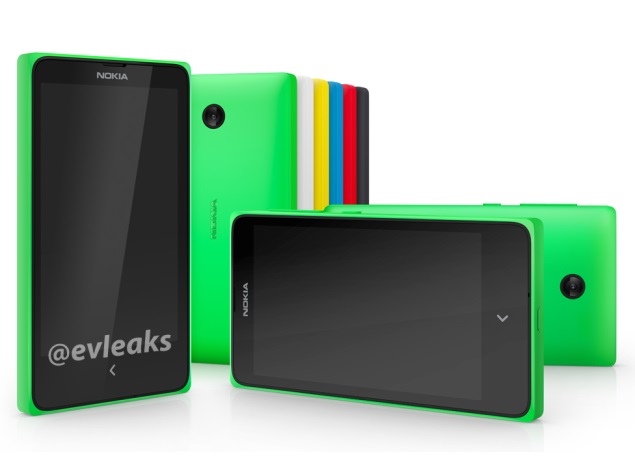
@evleaks has posted a render showing Nokia's alleged first Android smartphone, Normandy in various colour variants. The tweet reads, "Nokia Normandy, 2013" and includes the purported render of the device. The tweet also indicates that Nokia might launch the alleged Normandy by end of this year.
The Nokia Normandy's leaked render shows the yet-to-announced device sporting a similar design to the Asha touch range of phones. There is a physical back button on the front panel of the alleged Normandy, as seen in leaked render. The rear panel is seen with the camera accompanied by the Nokia logo branding in the middle. The rumoured Nokia Normandy can be expected to come in Black, Cyan, Mint Green, Red, Yellow and White colours, if the leaked render is believed.
If the rumours turn out to be true, Nokia, which has been supporting the Windows Phone platform like a lone ranger, might be finally changing gears and entering Android segment with its first device.
Earlier, a report had claimed that the Finnish handset maker might launch the Normandy in 2014 and described the Nokia Normandy efforts as 'full steam ahead'. The report also revealed that Nokia, following the lead of Amazon, has been working on a fully-tailored or forked version of Android, like the software on the online retail giant's Kindle Fire tablet range.
Further, the alleged Nokia Normandy has been said to be targeted at the low-cost segment as an Asha-equivalent smartphone, but with access to more traditional smartphone apps - a benefit that the report suggested has been missing in Nokia's dated Series 40-based Asha phones.
As of now, there is no clarity whether the alleged Nokia Normandy Android phone is real or just a rumour. However, contradicting the rumours about a Nokia Android phone, Stephen Elop, the former CEO of Nokia had said in July that the company made the right decision by choosing Windows Phone over Android.

Google asks US court to rule that Android has not infringed Rockstar patents


Google has asked a court in California to rule that it does not directly or indirectly infringe seven patents of Rockstar Consortium, after the Microsoft, Apple, BlackBerry, Ericsson and Sony backed patent firm sued seven of Google’s Android partners in a court in Texas.
The lawsuits filed in October in U.S. District Court for the Eastern District of Texas, Marshall Division, have placed a cloud on the Android platform, threatened Google’s business and relationships with its customers and partners and its sales of Nexus-branded Android devices, and created a justiciable controversy between Google and Rockstar, Google wrote in a complaint this week in U.S. District Court for the Northern District of California.
Rockstar acquired Nortel Networks’ patents for US$4.5 billion after outbidding Google in 2011. It filed lawsuits in October against Samsung Electronics, HTC and five other companies alleging infringement of some or all of seven patents.
Samsung’s Mobile Hotspot feature, which allows sharing of a mobile device’s data connection with other devices by turning it into a wireless access point, is alleged to infringe claims of U.S. Patent No. 6,128,298 (“the ‘298 patent”) entitled “Internet Protocol Filter,” for example.
Describing the lawsuits by Rockstar as “Android OEM actions,” Google said in its filing that Rockstar has asserted its patents only against “certain mobile communication devices having a version (or an adaption thereof) of [the] Android operating system.” Each of the “Android OEM Defendants” also makes other products that do not use Google’s Android platform, Google added. Rockstar has also alleged patent infringement by Nexus 7, a device offered for sale by Google and built by Asus, one of the “Android OEM Defendants,” according to the filing.
Google claims that its Android platform and the Nexus 5, 7 and 10 devices it sells directly or indirectly do not infringe any claim of the seven patents in the suit. It has asked the court for a declaration that both Android and the Nexus devices do not infringe Rockstar’s patents.
The Internet company has described Rockstar as a firm that “produces no products and practices no patents” in its filing. “Instead, Rockstar employs a staff of engineers in Ontario, Canada, who examine other companies’ successful products to find anything that Rockstar might use to demand and extract licenses to its patents under threat of litigation.”
Google said the California court had jurisdiction as, among other reasons, Rockstar’s shareholders like Apple in Cupertino, California, “direct and participate in Rockstar’s licensing and enforcement efforts against companies in California.”
In a separate action, Rockstar and subsidiary NetStar Technologies have alleged that Google has infringed seven other patents acquired from Nortel. The patents, all titled “Associative Search Engine,” relate to an invention used to provide advertisements based on users’ search terms. Google has asked for a 30-day extension of time to file its response to the complaint, which was granted by the court in Texas. Advertisements around search terms is a key component of Google’s business.

src : http://www.pcworld.com/article/2083040/google-asks-us-court-to-rule-that-android-has-not-infringed-rockstar-patents.html

Simple tips that can make your new Android phone better

Did you find a new Android phone among your holiday gifts? Well here’s another gift: Five of them, actually. These tips and apps will make that new Android phone even better.

don’t know how many people found an Android smartphone among their holiday gifts although I suspect it was more than a few. There’s no lack of good options available from Samsung, HTC, LG, Motorola and others. No matter what Android phone you might have unwrapped, however, there are a few easy things you can do to make the experience a great one.


  1. Find a keyboard that works the way you do. I actually like the stock Google keyboard that comes with Android, but everyone is different. Luckily, Android lets you install and use the keyboard — or keyboards, for that matter — you prefer. A quick search in the Google Play store will get you started but most people can’t go wrong with SwiftKey.      

Sunday, November 10, 2013

Easy , Understandable and Simple definition of - Big Data


Wednesday, November 6, 2013

MobileIron advances Android MDM

Summary: Improvements in security and management for Android devices by MobileIron should make Android deployment an easier and safer decision.

Android is cleaning up in market share for smartphones, but it's still a dodgy bet in the enterprise. The security architecture has always been a few steps behind that of Apple's iOS, and even third party products have had a hard time filling in the gaps. 
Now MobileIron, one of the leading Mobile Device Management (MDM) companies, is announcing improvements in their Android support with the goal of making it a safe choice for the enterprise. Already, according to the company, more than half of their customers are using Android devices under management by MobileIron; 30 customers have over 1000 Android devices under management. But IT still sees Android as risky, and deployed iOS devices vastly outnumber Android devices.

The highlights of the announcement are:

    Containerized Native Email. Mobile Application Management (MAM) products allow developers to "containerize" an app to make it manageable and to provide fine-grained security. But they can't containerize the pre-loaded Android apps like the Mail client. MobileIron, as part of a partnership with Divide (formerly Enterproid), will provide a containerized version of the native Android Mail client built from the Google Android distribution.
    Because it's the standard Android Mail app, users will have a familiar experience and the app should work on all Android distributions.  It can be managed from the same MobileIron console as other managed apps, allowing IT to impose policies such as: encrypt all content, run app in secure container, block copy paste with unprotected apps, run embedded URLs through MI secure browser, and so on.

    A containerized IBM Notes Traveler app. There are still many Notes installations and they are at very large corporations. A secure and manageable app will be appealing to these companies.
    Validated FIPS 140-2 encryption. Encryption for data at rest and in motion by MobileIron has been certified by an accredited lab for FIPS 140-2 Level 1. Support for this standard is often required for government agencies and regulated businesses.
    Secure tunneled browsing. Traffic to and from Web@Work, the MobileIron secure web browser, will travel through Sentry, the MobileIron secure gateway, making a device-wide VPN less necessary. Sentry provides a single sign on for both web and native apps under management, and uses Kerberos Constrained Delegation (KCD) to get a Kerberos ticket. This ticket can be used to access enterprise resources within the enterprise network.
    Samsung KNOX support. MobileIron is the first commercial licensee of Samsung KNOX. KNOX devices, such as the Samsung Galaxy S4, are not enabled for KNOX out of the box. You need a license key and a service to manage the device. MobileIron now provides that, using KNOX native facilities for containerization and policy.

MobileIron expects Android deployments in the enterprise to accelerate, in part because of a September recommendation by Garner that customers move off of Blackberry. Rather than be locked into iOS, they will grow their Android usage. For certain applications, such as ruggedized deployments (a market that had been dominated by the old Windows Mobile), Android is especially appealing, as OEMs can customize many features as needed.


MobileIron_for_Android_620


By for Zero Day |

Thursday, August 29, 2013

Pressy adds a physical, programmable button to Android phones

via  http://www.theverge.com By Nathan Olivarez-Giles on  


Android phones nowadays are largely devoid of physical buttons — save for the typical duo of volume and power keys. But Pressy, a Kickstarter project that promises to bring a programmable physical button to nearly any Android device, is challenging the idea that consumers are happy doing everything on a touchscreen. With 45 days left to go, Pressy's creators, Nimrod Back and Boaz Mendel, have raised more than $92,000. Pressy surpassed its stated $40,000 goal in less than 24 hours. To put it simply, Pressy is taking off.
The idea behind the project is a simple one: use a standard 1/8-inch headphone jack (but without the headphones) to create a diminutive but easy to find button. When installed, Pressy can perform a number of straightforward operations such as launching a phone's camera app, starting a voice recording, opening up settings, activating the flashlight, or any other number of other options. Each action is assigned to the button in an a Pressy app. According to Back and Mendel's Kickstarter page, Pressy can even be set to perform multiple functions by defining what happens with single or double short or long clicks — basically, the inputs are morse code.


The way Pressy works is by running on Android as a background service. The duo says that their app monitors the headset jack, but only really does anything when Pressy is clicked, which should prevent the button from draining battery life. The Pressy app, and therefore the actual hardware, works on any device running Android 2.3 or newer. And once the app is set up, Boaz and Mendel say users will even be able to use the mic button on a set of headphones to perform the same actions the Pressy button would.

BRINGING BACK BUTTONS
Since Pressy isn't yet a real consumer product — the pair says it'll take about four months before the buttons are shipping to donors — we can't say how well the device will work in the real world, especially on the many, many different Android phones out there. But, if you want to give Pressy a shot, the asking price isn't much. For a $17 pledge, donors will get the button and the app. Or if you're feeling really spendy, $45 can buy a gold-coated Pressy button with a matching key chain holder.