Showing posts with label Android. Show all posts

Friday, December 27, 2013

Nokia Normandy budget Android phone leaked again in new purported render


Nokia may not have officially revealed plans for making Android devices, but rumours about the company's first Android-powered smartphone, thought to be codenamed Normandy, are buzzing again.
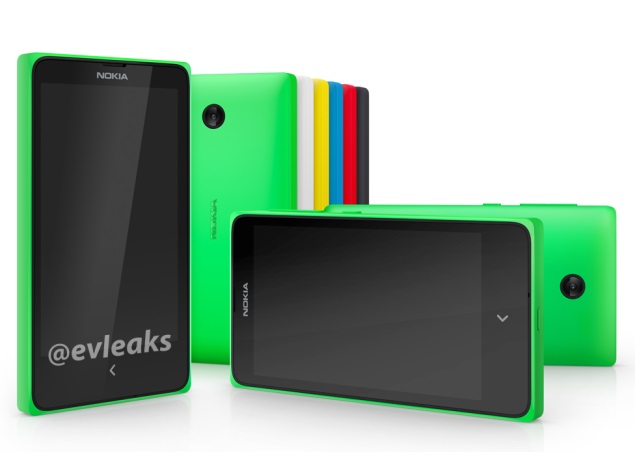
@evleaks has posted a render showing Nokia's alleged first Android smartphone, Normandy in various colour variants. The tweet reads, "Nokia Normandy, 2013" and includes the purported render of the device. The tweet also indicates that Nokia might launch the alleged Normandy by end of this year.
The Nokia Normandy's leaked render shows the yet-to-announced device sporting a similar design to the Asha touch range of phones. There is a physical back button on the front panel of the alleged Normandy, as seen in leaked render. The rear panel is seen with the camera accompanied by the Nokia logo branding in the middle. The rumoured Nokia Normandy can be expected to come in Black, Cyan, Mint Green, Red, Yellow and White colours, if the leaked render is believed.
If the rumours turn out to be true, Nokia, which has been supporting the Windows Phone platform like a lone ranger, might be finally changing gears and entering Android segment with its first device.
Earlier, a report had claimed that the Finnish handset maker might launch the Normandy in 2014 and described the Nokia Normandy efforts as 'full steam ahead'. The report also revealed that Nokia, following the lead of Amazon, has been working on a fully-tailored or forked version of Android, like the software on the online retail giant's Kindle Fire tablet range.
Further, the alleged Nokia Normandy has been said to be targeted at the low-cost segment as an Asha-equivalent smartphone, but with access to more traditional smartphone apps - a benefit that the report suggested has been missing in Nokia's dated Series 40-based Asha phones.
As of now, there is no clarity whether the alleged Nokia Normandy Android phone is real or just a rumour. However, contradicting the rumours about a Nokia Android phone, Stephen Elop, the former CEO of Nokia had said in July that the company made the right decision by choosing Windows Phone over Android.

Google asks US court to rule that Android has not infringed Rockstar patents


Google has asked a court in California to rule that it does not directly or indirectly infringe seven patents of Rockstar Consortium, after the Microsoft, Apple, BlackBerry, Ericsson and Sony backed patent firm sued seven of Google’s Android partners in a court in Texas.
The lawsuits filed in October in U.S. District Court for the Eastern District of Texas, Marshall Division, have placed a cloud on the Android platform, threatened Google’s business and relationships with its customers and partners and its sales of Nexus-branded Android devices, and created a justiciable controversy between Google and Rockstar, Google wrote in a complaint this week in U.S. District Court for the Northern District of California.
Rockstar acquired Nortel Networks’ patents for US$4.5 billion after outbidding Google in 2011. It filed lawsuits in October against Samsung Electronics, HTC and five other companies alleging infringement of some or all of seven patents.
Samsung’s Mobile Hotspot feature, which allows sharing of a mobile device’s data connection with other devices by turning it into a wireless access point, is alleged to infringe claims of U.S. Patent No. 6,128,298 (“the ‘298 patent”) entitled “Internet Protocol Filter,” for example.
Describing the lawsuits by Rockstar as “Android OEM actions,” Google said in its filing that Rockstar has asserted its patents only against “certain mobile communication devices having a version (or an adaption thereof) of [the] Android operating system.” Each of the “Android OEM Defendants” also makes other products that do not use Google’s Android platform, Google added. Rockstar has also alleged patent infringement by Nexus 7, a device offered for sale by Google and built by Asus, one of the “Android OEM Defendants,” according to the filing.
Google claims that its Android platform and the Nexus 5, 7 and 10 devices it sells directly or indirectly do not infringe any claim of the seven patents in the suit. It has asked the court for a declaration that both Android and the Nexus devices do not infringe Rockstar’s patents.
The Internet company has described Rockstar as a firm that “produces no products and practices no patents” in its filing. “Instead, Rockstar employs a staff of engineers in Ontario, Canada, who examine other companies’ successful products to find anything that Rockstar might use to demand and extract licenses to its patents under threat of litigation.”
Google said the California court had jurisdiction as, among other reasons, Rockstar’s shareholders like Apple in Cupertino, California, “direct and participate in Rockstar’s licensing and enforcement efforts against companies in California.”
In a separate action, Rockstar and subsidiary NetStar Technologies have alleged that Google has infringed seven other patents acquired from Nortel. The patents, all titled “Associative Search Engine,” relate to an invention used to provide advertisements based on users’ search terms. Google has asked for a 30-day extension of time to file its response to the complaint, which was granted by the court in Texas. Advertisements around search terms is a key component of Google’s business.

src : http://www.pcworld.com/article/2083040/google-asks-us-court-to-rule-that-android-has-not-infringed-rockstar-patents.html

Simple tips that can make your new Android phone better

Did you find a new Android phone among your holiday gifts? Well here’s another gift: Five of them, actually. These tips and apps will make that new Android phone even better.

don’t know how many people found an Android smartphone among their holiday gifts although I suspect it was more than a few. There’s no lack of good options available from Samsung, HTC, LG, Motorola and others. No matter what Android phone you might have unwrapped, however, there are a few easy things you can do to make the experience a great one.


  1. Find a keyboard that works the way you do. I actually like the stock Google keyboard that comes with Android, but everyone is different. Luckily, Android lets you install and use the keyboard — or keyboards, for that matter — you prefer. A quick search in the Google Play store will get you started but most people can’t go wrong with SwiftKey.      

Thursday, April 18, 2013

Android 4.1.1 rolls out to Sony Xperia S tablet today

Owners of Sony's Xperia S tablet will finally get a crack at Android 4.1.1, aka Jelly Bean, early today.
Sony expects to push the update to its production server sometime between 9:00 a.m. and 10:00 a.m. PT. Xperia S owners will then receive a notice in the bottom right Notification Area alerting them that a system update is available. Users can also follow the steps outlined on Sony's System Update page to manually check for the latest Android flavor.
The update will be available in the U.S, Canada, and Latin America. Once the update is set to launch, Sony will provide futher information on Android 4.1.1 via its Release Notes page.


  via -http://news.cnet.com


Saturday, April 6, 2013

Zuckerberg: Google Can't Stop Facebook Home on Android

At Facebook‘s mobile strategy event yesterday, CEO Mark Zuckerberg was surprisingly confident of Google‘s inability and unwillingness to prevent Facebook from rolling out Home on Android, because of the search engine commitment to opennness.
But when Google realizes Facebook Home is hijacking Android, drawing users to the social network’s services and ads, away from Google’s, things might turn ugly.
Below are Zuckerberg’s comments on the matter:

Zuckerberg on the relationship with Google
Google is aware of what we are doing and we talked to them about this and all of that. But fundamentally Android is just a more open system, so we don’t have to work directly with them in order to build an experience like this. So we can even go deeper that we’re talking about today. They’ve designed Android from the ground up to support deep integration.

Can Google stop Facebook Home?
We think that Google takes its commitment to openness in this ecosystem really seriously. These features that we are plugging into aren’t like a surface feature of Android that you can easily paper over… they’re operating system really is designed from the ground up to support these things. And it is theoretically possible that they go back on there commitment to openness but I don’t think that they will and it will take a lot of effort, a lot of really concerted effort to change the rules of something like this and make the system different. So it won’t just be some subtle thing that they choose to do. It will have to be a complete 180˚ in their philosophy and promise of openness to the community if they go back.
 
But what if they decide to do it?
If 20% of the time that people are spending on their phones are in [Facebook] Home or in other Facebook experiences then I really think that they’re going to have a hard time making a rational decision to do that and looking at themselves in the face and saying that they are building the best experience that they can… Every company that I know wakes up in the morning trying to build the best experience. And Google too!
(src http://www.forbes.com)

Camera Trigger ,ShutterBox Turns Your Android Phone Into A Sophisticated, Sensor-Laden Remote

A new Kick-starter campaign from San Antonio-based Ubertronix, Inc. aims to turn your Android Smartphone into a wireless activator for DSLR. The mission follows others that offer similar devices, but this one, the brainchild of Josiah Leverich, who founded Ubertronix a little over a year ago to build camera remote hardware, has some unique elements, including a way to use your Smartphone as a lightning sensor for capturing remarkable storm photos.


Ubertronix began as a way for Leverich to build and market his Strike Finder camera trigger product, which is a dedicated piece of hardware that features built-in sensors to help capturing high-speed photography, and lightning specifically. The ShutterBox is an extension of that tech, which features a hot shoe-mounted receiver box that communicates wirelessly with your Android smartphone via Bluetooth. It uses the phone’s built-in sensors for triggering automatic shutter activation, including light sensors for lightning, as well as motion detection for capturing wildlife or other movement-based events.

shutterboxThe ShutterBox can also be used as a standard wireless remote for triggering single shots, time lapse, bursts of exposures and more. It’s even designed to be able to work with multiple slave units for capture across multiple cameras at once, or for triggering remote flashes in a studio setting.

The idea following ShutterBox is to leverage the devices already in users’ hands instead of making them invest in and learn new proprietary hardware. The ShutterBox receiver will still cost you $199 as a pre-order (or $249 retail), but since a lot of its features are app-based, there’s ample potential for later capability improvements and expansion.
(src 
http://techcrunch.com

Darrell Etherington

)


Monday, March 25, 2013

Android, iOS face heat from rivals Tizen, Ubuntu, others


WASHINGTON: A handful of new smartphone platforms are expected to become available this year, challenging the stranglehold of the two market leaders, Google's Android and Apple's iOS.

Android and Apple account for more than 90 percent of the surging smartphone market, and third place is being contested by BlackBerry and Microsoft's Windows Phone.

But phones using operating systems based on the open-source platforms Linux and Mozilla's Firefox will be hitting the market this year, most likely in emerging markets.
Among smartphone makers, "there is a consensus that there is room for a couple more operating systems," said Ramon Llamas, analyst with the research firm IDC.

"Maybe not globally, but in some markets which could be used as proving grounds."

An IDC survey showed Apple and Android accounted for 91.1 percent of all smartphones sold in 2012, but that new platforms are worth watching in a market with 46 percent growth last year.

The Mozilla Foundation, developer of the Firefox browser and a new mobile operating system, claims to have 17 operators on board and plans Firefox OS phones in Brazil, Colombia, Hungary, Mexico, Montenegro, Poland, Serbia, Spain and Venezuela.

The key player being watched, however, is Samsung, which is the biggest smartphone maker with some 40 percent of all Android phones but is planning new devices using Tizen, an operating system based on Linux.

The Tizen Association, which also includes France's Orange, Japan's NTT DoCoMo, China's Huawei and US-based Intel, say the firms "view openness as a key to raising the bar for user experience."

Some analysts were surprised by Samsung's move, saying it's not clear if the South Korean giant is trying to distance itself from Google and Android, which is a free operating system but offers advertising possibilities to the Silicon Valley firm.

"I wonder about Samsung's motivation," said Roger Kay of Endpoint Technologies.

"To get out from Google's control might be part of it, but I'm not sure how rational that is. The partnership has been very fruitful for both companies, and it's hard to see where the negatives are."

But Aapo Markkanen, an analyst with ABI Research, said Samsung is trying to break free from Google and that Tizen could be the key for that.

"All signs are pointing to Samsung trying to pull off a Great OS Escape within the next year or two," Markkanen said in a blog post, adding that the platform "will be given a kick start with the software and service portfolio that Samsung has accumulated" along with "Samsung's gargantuan marketing budget."

Other Linux phone systems are also readying their entry.

Ubuntu, a Linux-based operating system promoted by British software firm Canonical, expects to have phones ready later this year. And Sailfish, another Linux variant from Finnish-based Jolla Mobile, has released its program for developers.

Analysts say smartphone makers are seeking to mimic the success of Apple by controlling both the hardware and software "ecosystem."

"We are seeing more desire to control the whole user experience," said Gerry Purdy, analyst and consultant with the firm Mobile Trax.

A major challenge for any new platform, however, will be developing the applications that make up the ecosystem. These are key attractions for users of the iPhone and Android devices.

Although some apps can be developed across platforms using HTML5, a programming language that can be adapted for different devices, analysts say these are inferior to "native" apps developed for a specific platform,

"You can provide a reasonable experience with HTML5 and the browser, but the native app is smoother, cleaner and more natural," Purdy said. "It's pretty obvious when you watch them side by side."

Even a powerful firm like Samsung will have a hard time putting together an app ecosystem that can compete with Apple's App Store and Google Play.

"There is some open space, but putting together an entire ecosystem and doing that where there are established incumbents is a pretty iffy proposition," Kay said.

Because of these obstacles, Llamas said progress for any new system will be "long and slow."

"None of these things will happen overnight. There has to be time for gestation, reception and evangelization. And picking the markets will be important," he added. 


via